 All over the world, discussions are emerging on net
neutrality, online
censorship and surveillance as urgent topics. As we can see, companies
try to sell the internet service by service or even to sell data about
their clients in order to make more money. Similarly, some governments
whose aim is to control their citizens violate the principles of a neutral
web, free access to information and data protection by spying on the
population. Still, there are some countries, Nicaragua being one of
them, that are (almost) not subject to investigation. As a resident of
this country, I would like to contribute by giving an overview of issues
I am personally aware of, while noting that this article cannot be claimed
to be fully accurate.
All over the world, discussions are emerging on net
neutrality, online
censorship and surveillance as urgent topics. As we can see, companies
try to sell the internet service by service or even to sell data about
their clients in order to make more money. Similarly, some governments
whose aim is to control their citizens violate the principles of a neutral
web, free access to information and data protection by spying on the
population. Still, there are some countries, Nicaragua being one of
them, that are (almost) not subject to investigation. As a resident of
this country, I would like to contribute by giving an overview of issues
I am personally aware of, while noting that this article cannot be claimed
to be fully accurate.
First, this article gives a short overview of the main topics: censorship, net neutrality and surveillance. Afterwards it lists every ISP in the country with more detailed information.
Censorship
There has been only one case of censorship in Nicaragua publicly reported: In December 2011, Claro censored a website for unsatisfied customers: claroqueno.com (not available anymore). IP-based blocking was used, therefore not only one website but also other websites hosted on the same shared hosting package were not available anymore. Because of bad publicity the company repealed the censorship some weeks later. Furthermore, I heard through unconfirmed sources that between 2006 and 2012 websites with information on theft of services were made unavailable by Claro through IP blocking as well.
These are examples of how Internet Service Providers (ISPs) and other institutions can act arbitrarily in Nicaragua at any moment, without being aware of the seriousness of censorship.
Net neutrality
The larger companies in Nicaragua violate the principles of net neutrality, while all the smaller Internet Service Providers (ISPs) offer unrestricted internet access. Mobile internet is generally more limited than residential connections.
Yota, the second largest ISP in the country, is the only one limiting residential internet connections. It throttles the speed on BitTorrent ports, which are generally used for file sharing.
There are also rumors that when an account reaches a monthly limit (30GB), Yota throttles down the speed for this specific account until the end of the month.
Both cell phone network operators (Claro and Movistar) offer mobile internet packages (3G, HSDPA and UMTS) limited by the amount of transferred data. This is not yet a full net neutrality infraction, but it is worth mentioning, as there is a worldwide tendency to sell limited mobile internet.
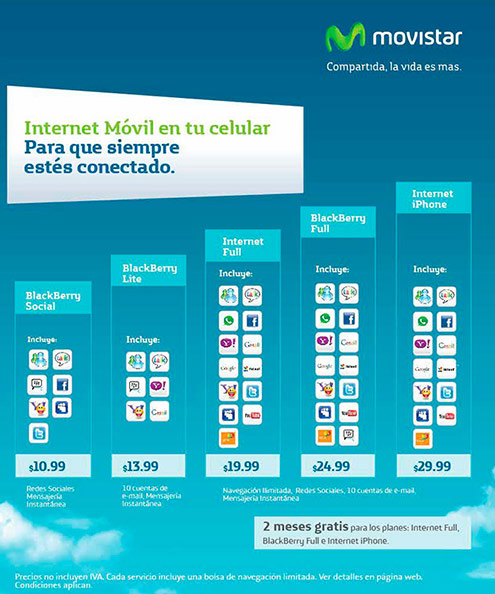
Besides that and even worse, both operators offer special plans to use certain applications exclusively (like Facebook, WhatsApp or Email), which leads us toward an internet that is sold application by application.
Surveillance
No active surveillance has been reported so far, nor any abuse by telecommunication companies or the Nicaraguan government. The government, as in most countries around the world, aims to have centralized control over all national internet exchange points, as well as the main telecommunication infrastructure and ISPs. However, the political opposition and the national press recently brought up concerns about governmental surveillance through a planned, but not completed, modification of article 92 of the Nicaraguan constitution (see the articles in La Prensa). But this looked to be more of a political play, as the planned modifications would not have had any legal effect at all on surveillance of the population. But we can assume that all of Nicaragua’s communication can be or is intercepted by the government due to the fact that the main infrastructure is controlled by governmental institutions. This is the case in all countries (from my point of view) and especially after the worldwide NSA scandal we learned that most countries should have control over their main communication infrastructure. Anyway, keep your data encrypted no matter where you are!
Internet Service Providers
The following ISPs do not censor or limit the internet in any way:
- IBW (residential and corporate)
- Tigo Business, merger of former Amnet and Navega (corporate)
- Ideay (corporate)
- Alfa (corporate)
- Netport (corporate)
- Alliance (corporate) belongs to Claro
- Nic@Net (residential and corporate)
- WiFiNic (corporate)
- BT Nicaragua (corporate)
All of these are smaller Internet Service Providers, mainly available to the corporate sector. Together they had a market share of 14.29% in 2011 [TELCOR].
The bigger ISPs are the ones that are involved in net neutrality issues:
Claro
The multinational communication company Claro offers its services in a lot of Latin American countries and is owned by Carlos Slim Helú (richest man in the world). Claro also holds the Nicaraguan market strongly in its hands (65.74% of Internet connections in 2011 [TELCOR]). Claro, besides being an ISP, is the biggest provider of landlines, cell phones and television via cable or satellite.
In December 2011, Claro censored a site for unsatisfied customers: claroqueno.com (not available anymore). Claro’s clients could not visit this site for some weeks. Because of bad publicity the company repealed the censorship in less than one month.
Unconfirmed sources informed me about Claro blocking theft of service websites, for example plexinium.com.ni (not available anymore), from 2006 until 2012, also using IP blocking techniques.
No recent blocking by Claro has been reported in 2013.
As the biggest service provider for cell phones (60.78% in 2011 [TELCOR]), Claro sells mobile internet as pre-paid packages or regular plans, with a limit on the maximum amount of transferred data.
There are also special offers based on specific services — for example, a package that includes Facebook only for pre-paid customers, or social networks with free SMS for one day (see picture number 3), and other questionable offers.

Yota
A relatively new player on Nicaragua’s telecommunication market is the Russian company Yota, which offers WiMax to individuals and fiber optic connections for corporate clients. Nevertheless, Yota became the second biggest ISP with 11.21% in 2011 [TELCOR]. The company provides services only in the capital, Managua, and one nearby city, Masaya. Yota commits the biggest violation of net neutrality by limiting the internet speed on the ports of BitTorrent (ports 6881 to 6969). When I asked Yota’s public relations contact for an explanation of the selective throttling of the internet, I received no comment.
Additionally, an unconfirmed source informed me about Yota limiting speed down to 2Mbit for the rest of the month after an account has downloaded over 30GB of data within the same period.
Movistar
Movistar is the second biggest cell phone network operator (39.22% in 2011 [TELCOR]) and the third biggest ISP with a market share of 8.76% in 2011 [TELCOR]. It is owned by the internationally known Telefonica. I have no information on limitations for residential internet. Cell phone internet is sold by pre-paid transfer packages valid for different numbers of days: 150Mbyte a day, 300Mbyte/three days, 500Mbyte/one week or 1GB/15
days. There are also special internet plans offering access to certain
applications or protocols at different prices. This is a clear violation
of net neutrality — rather than offering open internet access, users
are charged separately for each service they wish to use. This is what
net neutrality violations look like when advertised in Nicaragua: